
The History of Kippur Yom in Earliest Israel
Dr. Alyssa M. Cady
Director, Temple Emanu-El Center for Interfaith Dialogue
Adapted from a lecture given on Yom Kippur, October 12, 2024.
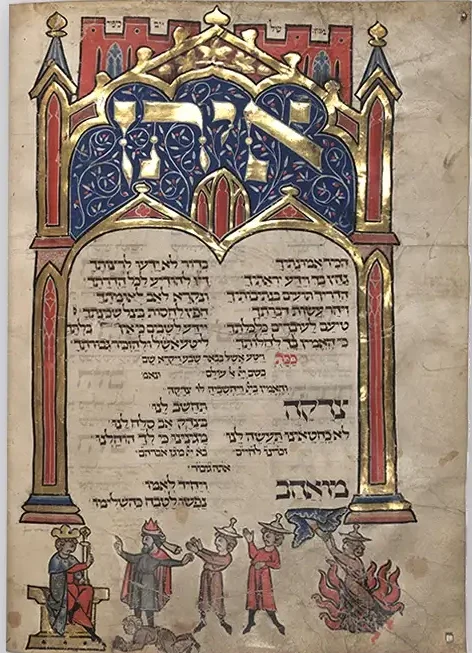
In modern times, Yom Kippur is a day of elevated holiness, of reflection and seeking forgiveness, and of special observances such as fasting, charitable giving, and prayer. Also known as the Day of Atonement, services on Yom Kippur may include readings from the books of Leviticus and Jonah, the chanting of the kol nidrei, and the ceremonial blowing of the shofar. Many of these traditions are rabbinic in origin. Indeed, rabbinic discourse and practice in the synagogue has shaped the observance of Yom Kippur since the late antique period.
Yet prior to the rise of rabbinic Judaism, the Day of Atonement centered on the Temple and the priests who attended it. Until two-thousand years ago, it was the High Priest who oversaw the observance of Yom Kippur, and whose responsibility it was to make atonement on behalf of himself and the community. In this discussion, we will explore the earliest evidence for Yom Kippur and bring it into conversation with other ancient Near Eastern cultures.
Atonement in Ancient Times
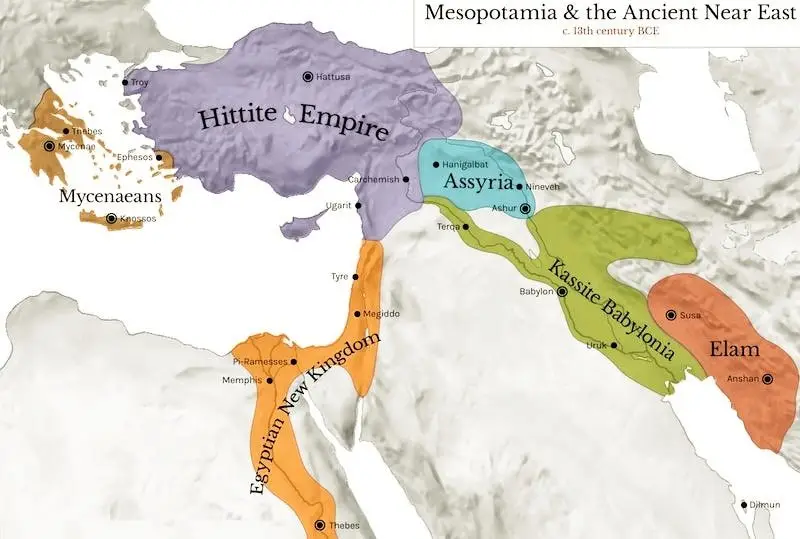
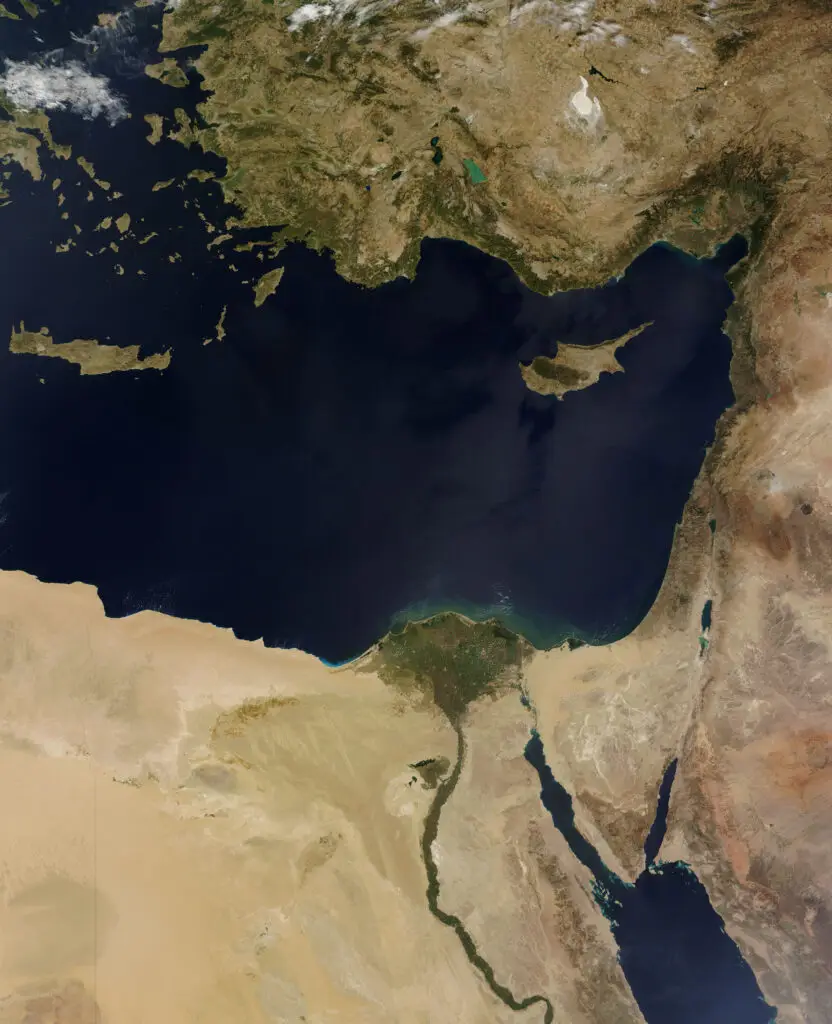
We begin some thirty-five hundred years ago in the ancient Near East and Mesopotamia, shown left. Spanning modern-day Greece, Turkey, and Egypt, the ancient Near East joined with Mesopotamia to form a broad cultural, political, and military network in the Bronze and Iron Ages. Here we find the world’s first true empires, such as the Hittite Empire, Assyria, Babylonia, and Egypt. These major powers will form the sociopolitical backdrop to the earliest rites of atonement known to the world and will inform our understanding of early Israelite observances.
In figure 3, we see a small strip of land connecting the Near East to Mesopotamia. This area is known as the Levant and forms the land bridge between Eurasia and Africa. The Levant refers to the island of Cyprus, as well as the narrow, arable land on the eastern Mediterranean coast. This strip of land stretches east to west from the Mediterranean and the Syro-Arabian Desert, north to south from the Sinai Peninsula, Taurus Mountains and the Euphrates. Because the Levant provided the only passage by which international trade could take place, it was a strategic region over which the earliest empires fought for control. While the Levant refers to the land itself, scholars further sub-divide the area into northern and southern regions. The northern Levant stretches from the Taurus Mountains through modern Lebanon and Syria. Here, Anatolian and Mesopotamian empires such as Akkadia, Hatti, and Mitanni exerted the greatest influence. Meanwhile, the southern Levant spans the Sinai Peninsula to modern Jordan. In the context of the late Bronze Age, scholars often refer to this area as Canaan, where Egypt remained dominant.
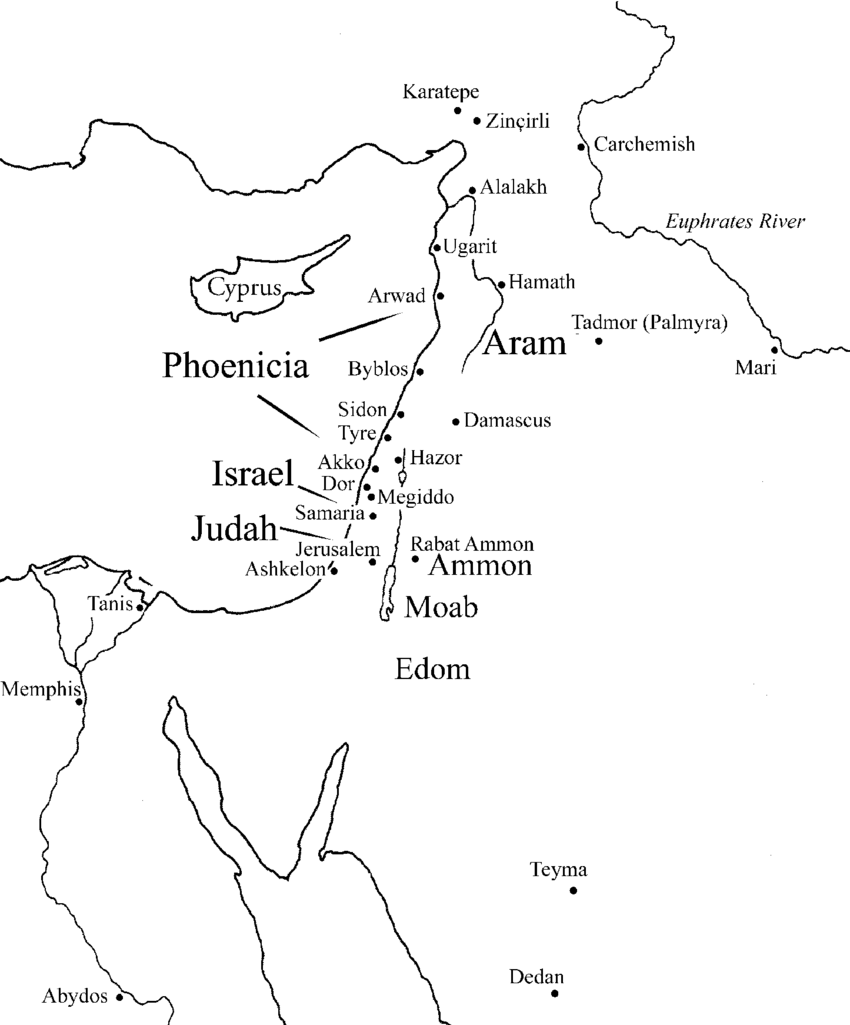
One theory holds that Near Eastern and Mesopotamian powers such as Old Babylon, Mycenaean Greece, and New Kingdom Egypt rapidly declined in what is known as the late Bronze Age collapse, beginning sometime around 1150 BCE. Though not universally excepted, some historians have argued that, without the hegemony of these larger empires, local Levantine powers developed into regional kingdoms and city-states. Shown in Figure 4, these include the kingdoms of Edom and Ammon, as well as the city-states of the regions of Philistia and Phoenicia. The biblical kingdoms of Israel (Samaria) and Judah allegedly arose in this context. Scholars loosely associate the so-called “united monarchy” described in the Bible with the 11th century, estimating that the kingdoms of Israel (Samaria) and Judah emerged as separate entities in the 10th and 9th centuries, respectively. It must be emphasized, however, that these dates are speculative, as little archaeological evidence exists from which to trace the emergence of Israel and Judah.[1]
Religion in the Levant
What do we learn from the tablets, archives, and other material evidence from the ancient Levant? How might the religious traditions of ancient Near Eastern societies shed light upon the earliest observances of the Biblical Day of Atonement? Put another way, what hath Hatti to do with Israel? The city-states and kingdoms of Canaan and the northern Levant had much in common with one another, both in terms of political organization and conceptions of humanity’s relationship to the superhuman and the divine. To start, religion in the Levant may be understood as a continuous, locally variably pantheon of gods, goddesses, and supernatural forces.
Israel inherited local cultural traditions from the LBA, and its culture was largely continuous with the Canaanite culture of the coast and valleys during the [early] Iron period. The realm of religion was no different…the deities of the land included El, Baal, Asherah, and Anat…
Smith, The Early History of God (29)
Monolatry – that is, the worship of a single god without denying the existence of other gods – arose over time to become a central issue in the Pentateuch, but polytheism was nearly universal in the Bronze and early Iron Ages. Canaanite cultures associated each god with different functions, realms of power, natural phenomena and cultural technologies. Narratives contributed to the understanding of the gods and humanity’s relationship to them, manifesting in the many epic myths, legends, scriptures, and other writing we know today – from the Babylonian Epic of Gilgamesh and the Greek hymns to Demeter, to the biblical account of Noah and the Flood.[2]

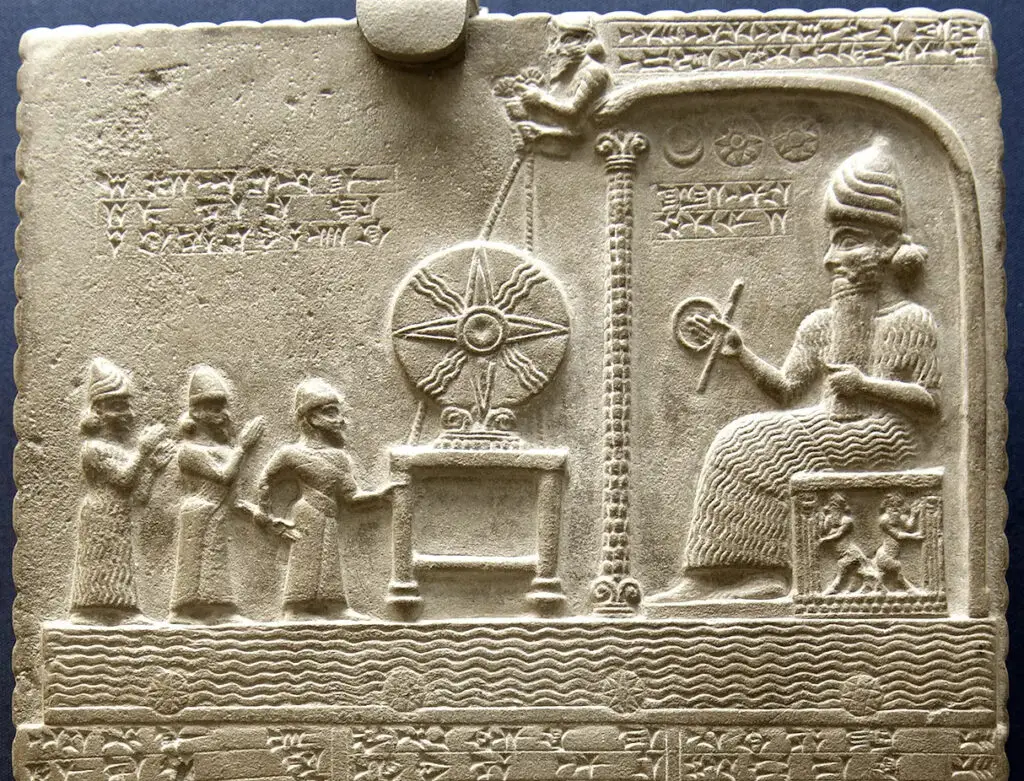
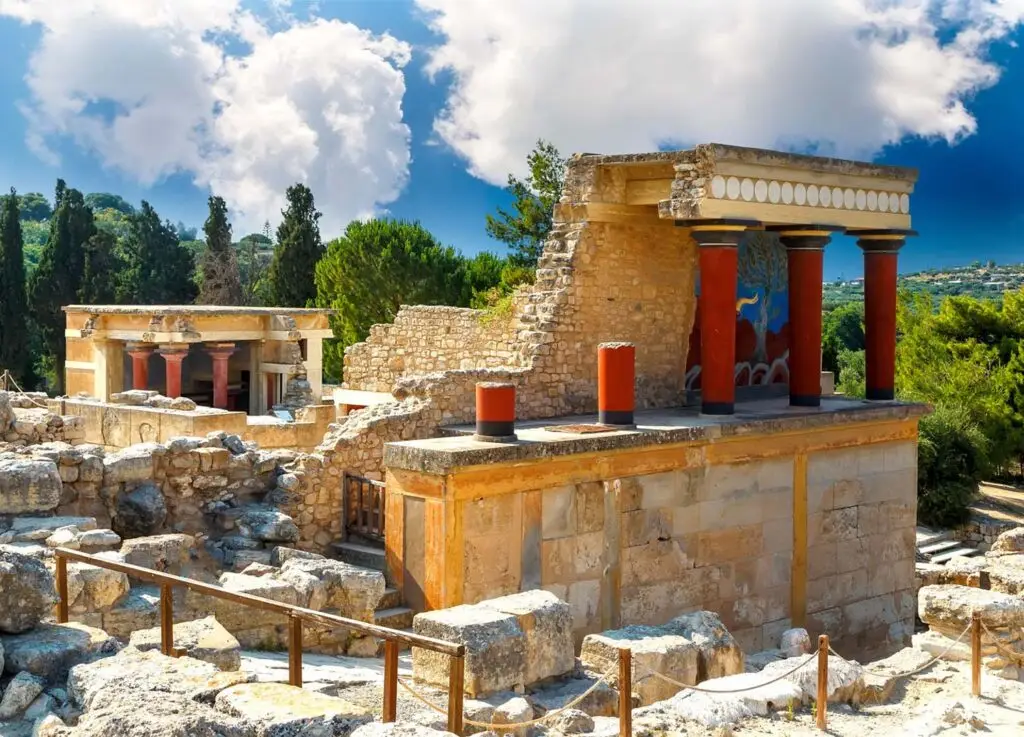
While private worship took place at home, ritual specialists (e.g., priests, exorcists) and dynastic families facilitated public worship. Ancient cities, kingdoms, and empires were likened to large-scale households, and thus it was the responsibility of the heads of house – the ruling class and the priests – to maintain a good relationship with the gods for the benefit of the community. Public worship centered on large urban temples and palace-shrines, from a rock-hewn temple in Canaanite Jerusalem (Fig. 6) to the opulent temple-palaces on the island of Crete (Fig. 7).
In addition to daily offerings to the gods, priests and aristocrats held large-scale banquets at which the gods were honored guests. These offerings and banquets involved devotional activities of many kinds, such as the cleansing of ritual spaces, the offering of prayer, incense, and libations, and – most potently – the regular performance of animal sacrifice.
Animal Sacrifice in Antiquity
Sacrifice has been described as “the essential ritual and religious act,” a near-universal practice in ancient Mesopotamia and the Near East, and archaeological evidence shows that the major ritual performed within Canaanite temples was sacrifice.[3] In his work, The Practice of Canaanite Cult, scholar Matthew Susnow explains that “sacrifice functioned in two ways, one as an offering to the deity in an act of gift, while the other as a mechanism for inviting the deities into the natural landscape, an invitation to imbue the profane with the sacred” (p. 223). Cultic architecture likewise played in important role in mediating animal sacrifice and social hierarchy:
With the introduction of standardized cultic architecture…these venues [temples, shrines, and palaces] became spaces in which the elites, like the gods, could play host to others, whether of equals or lower status segments of the population. Those who controlled the temple dictated who was to be invited [inside] and when, and for what purpose and to what extent their respective involvement in temple ritual would be…
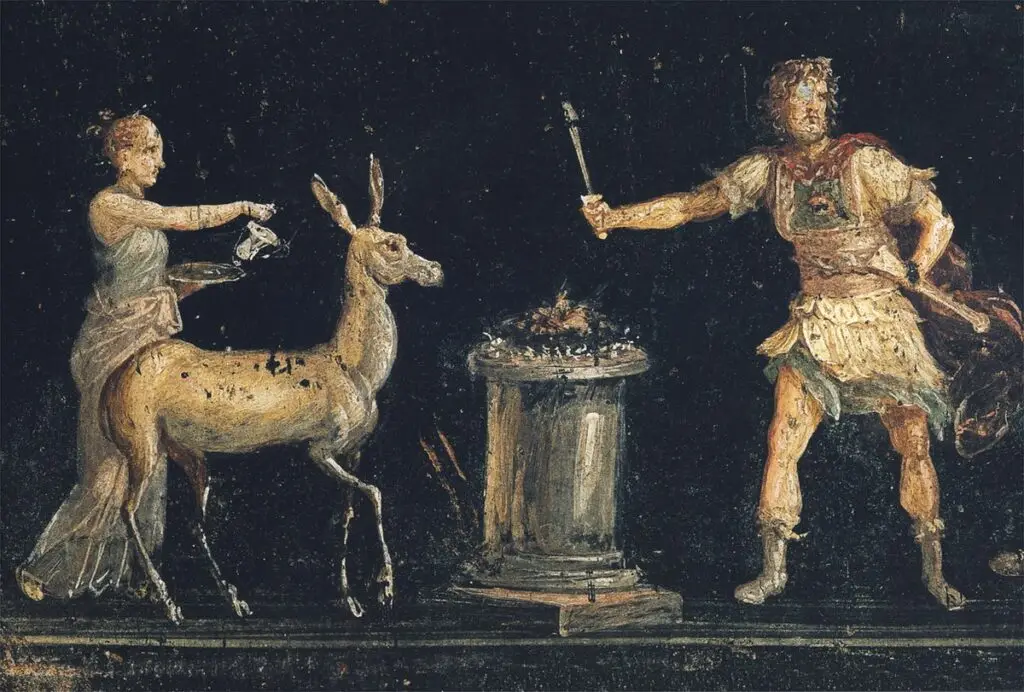
This is the socio-religious context necessary to reconstruct the earliest atonement rituals from which Yom Kippur developed. Born of a Near Eastern and Mesopotamian religious landscape, the Day of Atonement evolved out of a polytheistic world in which elite ritual specialists – the priests and the ruling families – communed with the gods through daily offerings and large-scale public banquets. Through the performance of sacrifice – predominantly of pastoral animals such as sheep, goats, and cows – these specialists dined with divine and ensured a good relationship between the people and their gods. One aspect of the reciprocal relationship between humankind and the divine was the expiation of sins and transgressions. Indeed, archaeological excavations have unearthed ancient atonement rituals from across the Levant and beyond, from the neighboring city-states of Ugarit and Ebla, and from great empires such as Hatti.
Leviticus: Observance in the Tabernacle
The earliest biblical evidence for the Day of Atonement comes from the book of Leviticus, which may be read as part of a sequence from Genesis to Numbers narrating Israel’s dealings with Egypt through its arrival in Canaan in the southern Levant. While Exodus narrates Israel’s flight into the desert and the building of the tabernacle, Leviticus focuses on the tabernacle services. The chapters of Leviticus form a thematic unit, which include offerings in the sanctuary, the ordination of priests, issues of ritual and moral purity, priestly qualifications, and finally festivals. At the center of Leviticus lies the Day of Atonement, the focal point of worship each year.[4] The tabernacle itself finds description in Exodus, the pre-temple sanctuary to the God of Israel. According to the biblical narrative, the tabernacle traveled with the Israelites through the wilderness before their arrival in Canaan and was attended by Aaron and his descendants. Its main features were the holy of holies, that is God’s dwelling place on earth, as well as the bronze altar and the bronze laver (or water basin) used for purification and sacrifice.
While the Day of Atonement occurs in Leviticus chapter 16, the biblical narrative provides a backstory to why atonement was needed in the first place. In addition to the various sins accrued by Israel over time (recall, for instance, Exodus’ prohibition against worshipping idols and Israel’s veneration of the golden calf), the priesthood itself needed to be cleansed after corrupting the holy of holies. This episode comes from Leviticus 10:1-2:
Now Aaron’s sons, Nadab and Abihu, each took his censer, put fire in it, and laid incense on it; and they offered unholy fire before the Lord, such as he had not commanded them. And fire came out from the presence of the Lord and consumed them, and they died before the Lord.
According to the compilers of Leviticus, Nadab and Abihu’s transgression required atonement for the priesthood, while Israel’s previous sins required atonement for the community at large. Leviticus 16 therefore details the Day of Atonement itself. It begins with preparations for the temple and the high priest, whose role it was to maintain the relationship between God and Israel. Following this is a sin offering for the high priest, himself, followed by another for the broader community. We then see atonement for tabernacle instruments, such as the incense altar and the altar of burning. This culminates in the most important part of the ritual –the scapegoat ritual – detailed in Leviticus 16: 6-7, 20-22:
He shall offer the bull as a sin offering for himself, and shall make atonement for himself and for his house. He shall take the two goats and set them before the Lord at the entrance of the tent of meeting; and Aaron shall cast lots on the two goats, one lot for the Lord and the other lot for Azazel. When he has finished atoning for the holy place and the tent of meeting and the altar, he shall present the live goat.
Then Aaron shall lay his hands on the head of the live goat, and confess over it all the iniquities of the people of Israel, and all their transgressions, all their sins, putting them on the head of the goat, and sending it away into the wilderness. The goat shall bear on itself all their iniquities to a barren region; and the goat shall be set free in the wilderness.
Following the ritual’s conclusion are washing, burnt offerings, and then a period of cleaning and cleansing.
The Scapegoat Ritual
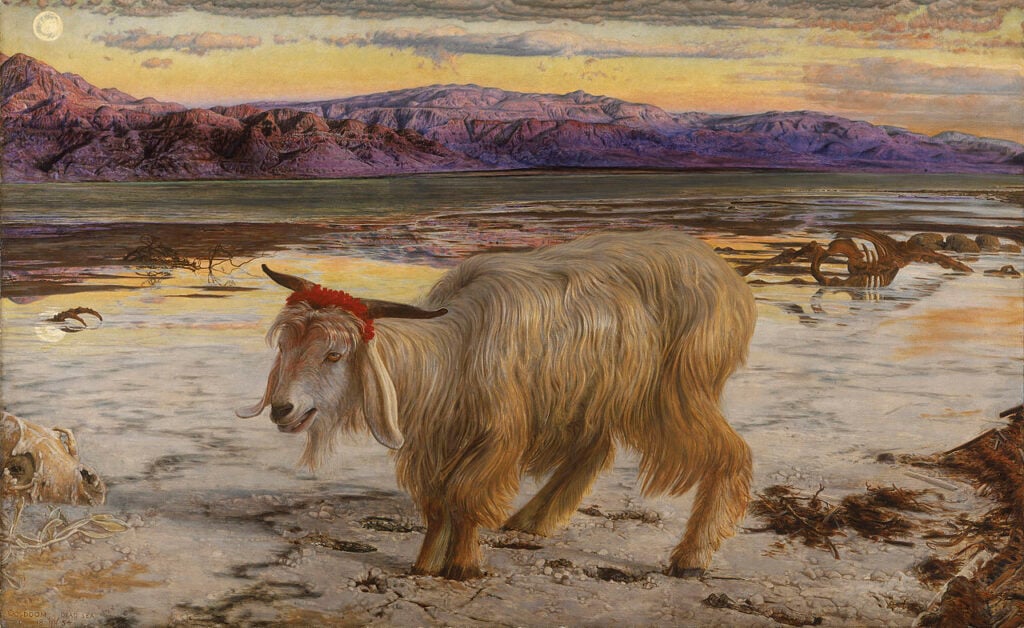
The scapegoat ritual is perhaps the most important part of the ancient Israelite ritual of atonement, and it is also the rite which bears the greatest similarities to other Near Eastern atonement rituals. In fact, archaeological excavations have recovered many rites of atonement from the ancient Near East and Mesopotamia. Some of these rites are very ancient, predating the biblical record by a thousand years or more.[5] Let’s look at some of the most ancient atonement rites in existence and see how they might compare to the biblical evidence.
Ebla
Our earliest point of comparison comes from ancient Ebla, a regional power in northwest Syria whose influence once extended as far north as the Anatolian border and as far south as the Sinai Peninsula. Ebla flourished over four thousand years ago, between 2600 and 2240 BCE,
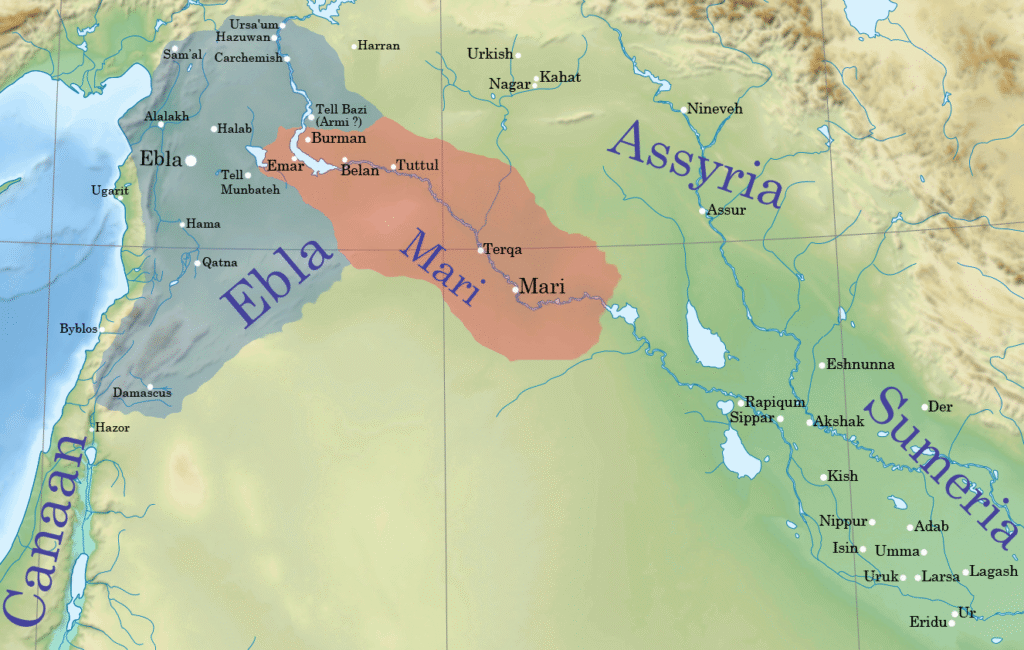
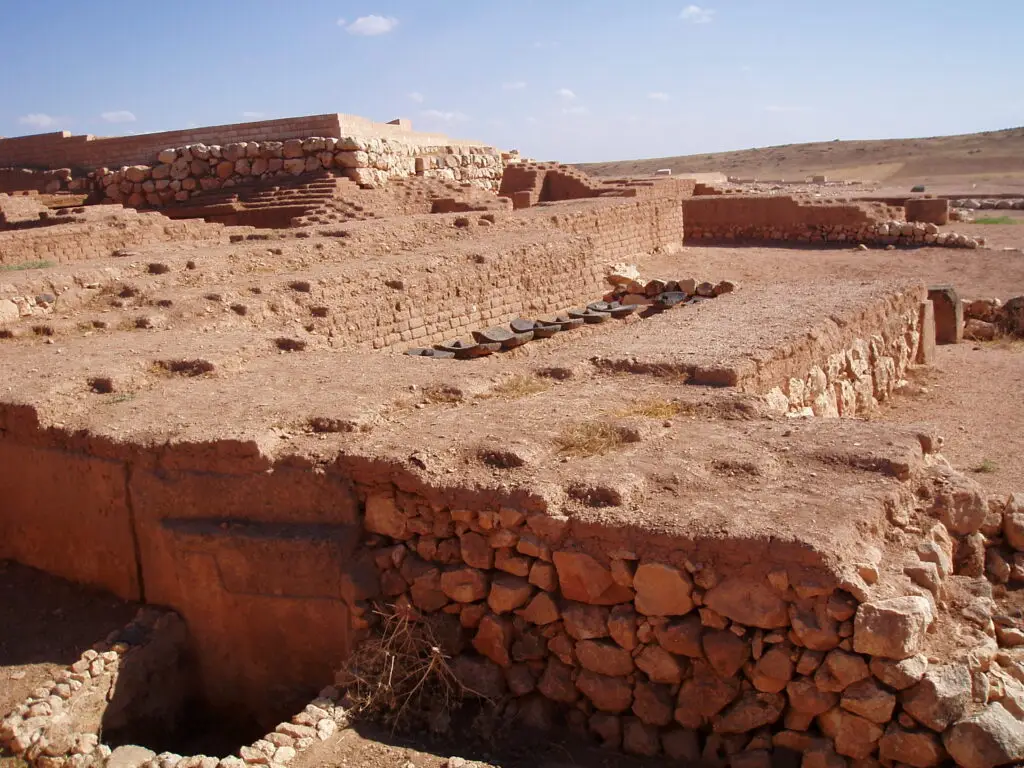
until the rise of the Akkadian Empire to the east. Here we find a highly developed culture for the early Bronze Age. Archaeologists have discovered an enormous cache of administrative and religious texts known as the Ebla Tablets. Dated to between 2500 and 2250 BCE, these many thousands of complete and fragmentary documents describe economic and poli
tical life at the height of Ebla’s power, and reference many cities and rulers mentioned in the Bible. The tablets also detail religious life in the early Bronze Age Levant, shedding light upon the pantheon common to ancient Canaan as well as gods unique to Ebla.
Additionally, they include at least one atonement ritual. Known as the Eblaite goat ritual, this tablet describes a scapegoat ritual in much the same terms as Leviticus but in a totally different context. The background to the Eblaite ritual is the queen’s wedding, as well her and her king’s enthronement, for which the mausoleum must be purified:
We purify the mausoleum before the entrance of [the gods] Kura and Barama. A goat, a silver bracelet [hanging from] its neck, toward the steppe of Alini we let it go.
Ugarit
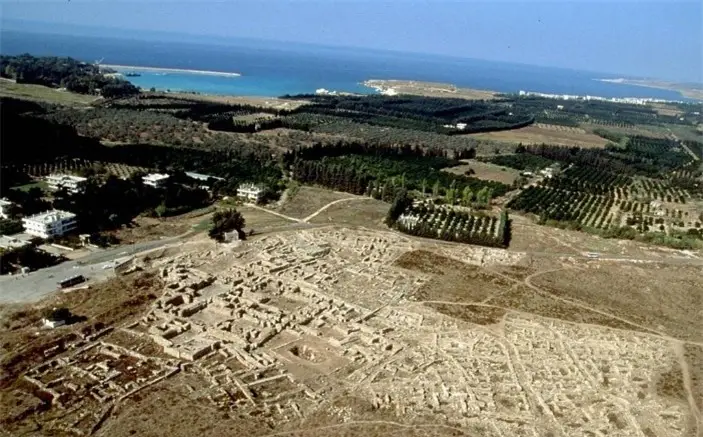
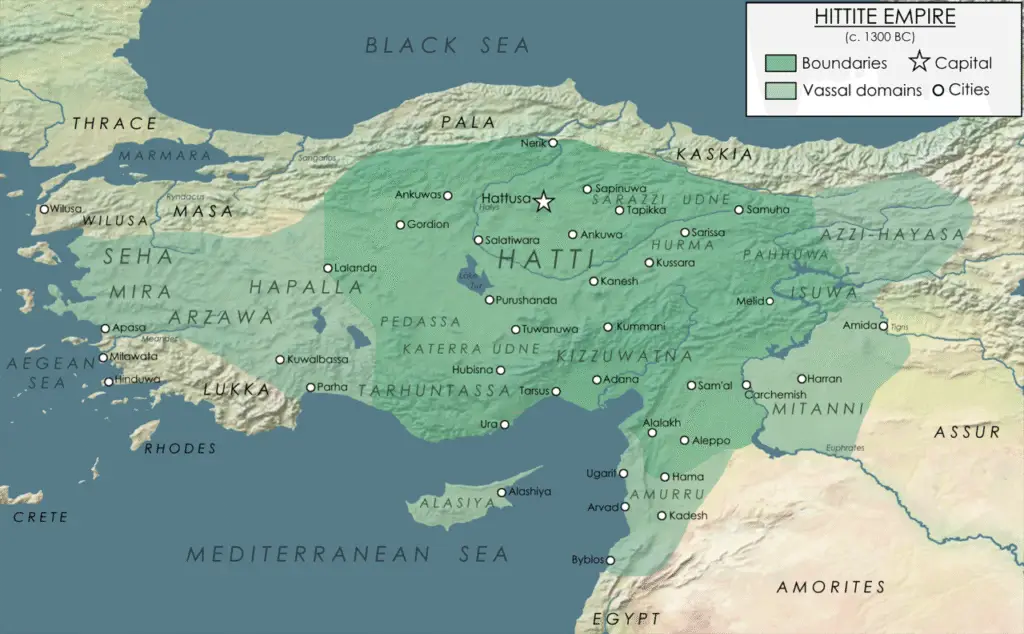
Roughly one thousand years later we come to a city-state in the northern Levant known as Ugarit, located on the coast of modern Syria. Known for its wealth and trade, it was a subject-state of Hatti, a bronze age empire ruled by the Hittites that controlled much of Anatolia (or modern Turkey).
Ugarit has very ancient origins, dating all the way back to the Neolithic Period some 6,500 years ago, but flourished in the late Bronze Age between 1600 and 1200 BCE. In the early 20th century, archaeologists also discovered a massive archive of cuneiform tablets revealing much about the economic, political, and religious life of the northern Levant. Known as the Ugarit archives, the cache of documents included many tablets that describe offerings to various deities in the Ugaritic pantheon. Not only does it list sanctuaries in Ugarit and the gods worshipped therein, but it also details contributions and offerings made by wealthy citizens and records recited rituals – including two atonement rituals.
The first is an atonement ritual found in a Ugaritic Manual, the ninth in a series of manuals describing rituals and spells. Dated to 1600 BCE, Ugaritic Manual 9 is a ritual text describing four offerings to the gods. The text lacks the exact prayers used in the ritual. Rather, the text describes the ritual procedure – that is, the ritual specialist would need to specify that sacrificial animal as well as the deity who would be invoked for the ritual to work. Ugaritic Manual 9 reads like a checklist, where line one specifies a “bull and a male of the flock for the gods”, line two requires a “male of the flock”, line three lists a “bull, a male of the flock to [the god] El”, and finally, the fourth atonement ritual requires a “female of the flock for the burnt offering and the offering of well-being.” Though Ugaritic Manual 9 may seem sparse at first glance, it bears much in common with the atonement rites found in Leviticus (Fig. 15).
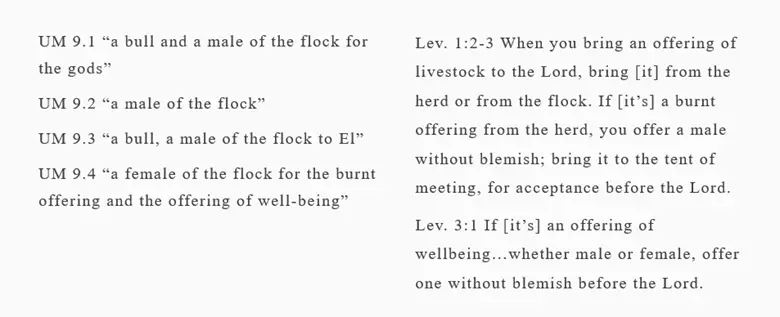
Let’s compare some of this language. First, we see two types of sacrifice describes in both Leviticus and at Ugarit, a burnt offering and an offering of well-being (sometimes called a peace offering). Both Israel and Ugarit sacrificed pastoral animals, primarily male bulls, which carried higher status than other animals and were preferred by the gods. Female cows, too, were sacrificed in association with offerings of well-being. Finally, for at least five hundred years – the distance in time between the Ugarit archive and the earliest portions of Leviticus 1-16 – ritual specialists needed to name which god or gods were the recipients of the offering. Note that the first ritual of Ugaritic Manual 9 offers sacrifice to multiple gods, while line three specifies that the god El is the intended recipient. Those familiar with the Pentateuch might recognize the name El, which could refer to a storm god in the Canaanite pantheon, to any god in Canaan, or even to the god of Israel specifically. To my mind, the greatest difference between the situation at Ugarit and that in Jerusalem is the narrative context in which the priests performed the rituals. The Ugaritic evidence lacks any story, legend, etc. that might culturally contextualize rites. How did the people of Ugarit understand atonement in relation to their own history? The compilers of Leviticus, meanwhile, understood the Day of Atonement to be a crucial part of their cultural and religious history.[6]
The second atonement ritual comes from a clay model of a lung on which is inscribed an ominous setting. Here, we see a religious last stand; should an army arrive at Ugarit’s gates, the people should send a goat to the wilderness:
If the city is about to be conquered, if death wickedly treats man, a person will take a goat in the steppe and send her out.
While lacking detail, this Ugaritic goat ritual closely resembles the scapegoat rituals described in Leviticus 16 and in the Ebla archives. Unlike the other scapegoat rituals, however, the issue here is not pollution but rather violence. Though the connection between violence and atonement may not be obvious to us, ancient Near Eastern civilizations believed that deities could strengthen military expeditions on the one hand, or even abandon entire communities to slaughter on the other. By sending out a scapegoat, Ugarit could have been atoning for sins accumulated against them, in a last-ditch effort to win a god over to its side. Thus, Leviticus, Ugarit, and Ebla all use similar rituals of atonement. The same animals, ritual procedures, and formulas are all present. The two biggest differences are the intended gods – though this, too, has overlap – and the narratives into which these rituals fit. Ugarit and Ebla are by no means the only Near Eastern parallels with which to compare the biblical Day of Atonement. Such a configuration of ritual atonement was not limited to the Levant, but extended far beyond it, to the empires and kingdoms of Anatolia, Egypt, and Mesopotamia.
Hatti
Beyond the Levant, we may turn to the Hittite Empire where many atonement rituals survive. An early empire based in Anatolia (modern Turkey), Hatti connected Europe to Egypt and Mesopotamia and flourished between 2400 and 1700 BCE. Politically and culturally, it dominated the northern Levant, including Ugarit. Hatti’s capital city was Hattusa, just north of central Anatolia.[7] Surrounded by concentric rings of fortifications, mountains and cliffsides, Hattusa was a highly defensible city with a large pantheon of gods and goddesses. This includes its central deity, the weather god Teshup, and his consort, the sun-goddess Arinna. At Hattusa, archaeologists have uncovered a scapegoat ritual involving a mouse, which reads as follows:
She (the exorcist) wraps a small piece of tin in a thread and binds it around the right hand and foot of the (ritual) patron[s]. Then she takes it
from them, binding it around a mouse, saying:
“I have taken the evil from you. I have bound it around the mouse. May this mouse carry it to the high mountains, to the deepest valleys, to the
long roads.” Then they release the mouse, saying:
“[To the gods,] Zarniza, Tarpattašši—You, take this for yourself, and we shall give you something else to eat.”
Mesopotamian Exempla
I will conclude this discussion with a final example of atonement rituals in Mesopotamia, where much evidence survives. Ancient menologies (logs of holidays by month) record a period of atonement in the month of Tishrei, the same month in which Yom Kippur takes place.[8] These menologies show that Tishrei was very important in the Near East and Mesopotamia as far back as 4,000 years ago. Astrologically, Near Eastern and Mesopotamian cultures accorded great significance to the constellation governing Tishrei (Libra, or the scales), which concerned the judgment of the living, the dead, and of souls. To cite but one example, an Old Assyrian (c. 2025 BCE—c. 1364 BCE) atonement ritual provides guidance on activities and foods either to be avoided or encouraged on each of the nine days leading up to the Day of Atonement, which takes place on the tenth day of the month.[9] I will excerpt a few of these provisions here:
On the 1st of Teshrit one may not face a heavy wind on the plane or the ballula demoness will wed him. Onions he may not eat, or a scorpion will sting him. Flesh of the tumanu pig one may not eat, it is an abomination to Enlil.
If one eats onions [on the 2nd of Teshrit,] an old man in the family will die. Fennel and watercress, cooked meat, and flesh of oxen, goats, and swine not to be eaten; all these rules if broken incur hatred, ulcers, and asthma. One may not descend into a well or ascend to the roof of a house.
[On this 6th day,] One may not come near a woman, ascend to a roof, descend into a well or garden, nor enter a laundry (bit musiiti). He may not cross a meadow, stand where a mortar has been laid, nor stand where asses have roamed.
Just as in the Levitical evidence, we see a formalized period of heightened purity culminating in a day of ritual atonement. Prohibitions against specific foods and behaviors restrict the practitioner’s diet, sexual activities, and even movements within the community. Transgression of these prohibitions incurs specific penalties, from medical ailments (ulcers and asthma) to sexual violence (“wedding” a ballula demoness) to causing the death of a family member. Although the Old Assyrian menology predates our oldest biblical material by at least five hundred years, one might recall prohibitions of a similar type, specifically those related to movement on Shabbat, the consumption of pork, and certain sexual activities.
What we see from the evidence, then, is a broad spectrum of cultural practices and exchanges. While atonement rituals took similar shape across the Levant and beyond it, local expressions gave color to the rituals by giving them narrative context. In the parallels discussed here today, we do not see the same historical setting for each ritual – rather, many rituals only occurred when the need arose, such as during royal weddings or in military contexts. What is consistent, however, is the close relationship between a community and the divine, and the emergence of ritual specialists, royal dynasties, elite persons whose responsibility it was to ensure the health of the community.
[1] Two highly significant inscriptions are the Merneptah Stele and the Nimrud Tablet. Dated to 1208 BCE, just prior to the late Bronze Age collapse, the Merneptah Stele records the earliest reference to a tribe or locality known as Israel. It commemorates the Egyptian victory over various Levantine powers, and describes Israel as being “laid waste without seed.” It would not be for another half a millennium until we see the first reference to Judah, in the Nimrud tablet dated to 733 BCE. Written in cuneiform, this tablet describes the reign of the Neo-Assyrian emperor, Tiglath-Pileser III, the very same emperor responsible for conquering the kingdom of Israel between 732 and 720 BCE. Not only does the tablet name a certain “Jehoahaz of the land of Judah” – known as King Ahaz from the book of Amos – it also mentions other Levantine powers such as Ammon, Moab, and the city-states of Gaza and Tyre.
[2] Ancient peoples believed that physical forms of the gods, such as statues, held the presence of the divine with them. To visit a shrine or temple and pay homage to a divinity’s statue was, in essence, to commune with the divine presence within. This concept may provide context for the absence of statues of Yahweh, the god of Israel, whose cult rose to prominence over the course of the Iron Age. Notably, no statue of Yahweh has ever been concretely identified, suggesting that his devotees avoided physical representations of this god. This aversion finds support in the Torah, whose compilers frequently narrate the monolatry and idolatry of various biblical kings. Indeed, Exodus 20, verses 4 and 5 read: “You shall not make for yourself an idol, whether in the form of anything that is in heaven above, or that is on the earth beneath, or that is in the water under the earth. You shall not bow down to them or worship them; for I the Lord your God am a jealous God…” [NRSV].
[3] Sociologists have described sacrifice in several ways, such as the essential ritual and religious act, as a as a group adhesive which kept the gods alive, as the vehicle for the ensuing communal meal, as a means of communication between the sacred and the profane Paraphrased from Matthew Susnow, The Practice of Canaanite Cult (pp. 35-36).
[4] While Leviticus describes the Day of Atonement as it was observed in the tabernacle, Yom Kippur also took place in the First Temple of Solomon as well as the Second Temple of Ezra-Nehemiah and King Herod.
[5] Scholars usually identify Leviticus 1-16 as a single unit which later redactors consolidated with other materials sometime in the Babylonian or post-exilic periods. Text critical scholars often date Leviticus 1-16 to the end of the Bronze Age, at around 1200 BCE or some 3200 years ago. By comparison, many Near Eastern parallels predate the Levitical evidence by hundreds of years, or even a millennium or more.
[6] Leviticus 1:3, for instance, references the tent of meeting. Described in Exodus 33:7, the tent of meeting refers to the pre-tabernacle tent where Moses and others sought to commune with God. It can also refer to the tabernacle.
[7] We also have evidence from the city of Šamuha, located a short way east of Hattusa. Dated to between 1500 and 1370 BCE, the Hittite ritual of Šamuha describes a ritual of atonement performed by a female exorcist on behalf of the king and queen. It reads: The exorcist releases one bull for the king, but one cow, ewe, and nanny goat for the queen’s implements—all as a nakušši (a “sent-away” animal)—and then declares as follows: “Whatever evil word, false oath, curse, or impurity has been committed in the sight of the deity—may these nakuššis carry them off from before the deity. May the deity and the ritual patrons (= king and queen) be purified of these things!”
[8] See: Langdon, S. Babylonian Menologies (1933) [available online]; Levine, B. “Ugaritic Descriptive Rituals” JCS 17 (1963): 105-111.
[9] Text found in Langdon, p. 101.